Article Highlights
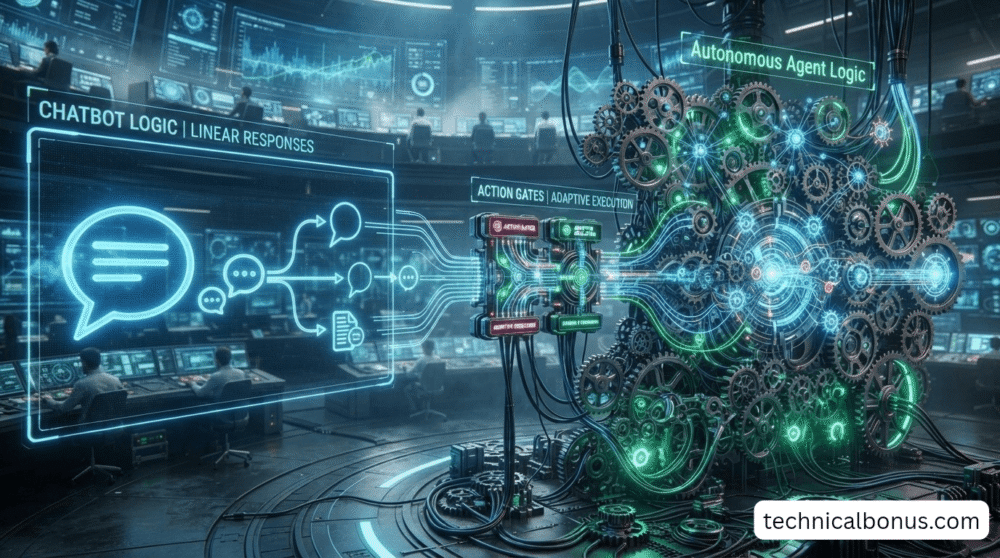
- Autonomous AI Agents vs Traditional Chatbots represents the evolution from “Answering Machines” to “Executing Machines.”
- The fundamental logic of Autonomous AI Agents verses Traditional Chatbots is rooted in the agent’s capability to browse the web, utilize tools, and correct its own errors without requiring human intervention.
- My 21-year technical legacy has seen the shift from manual scripts to neural reasoning; agents are the final stage of this logic.
- We analyze what hardware logic is required to run these agents privately [NPU vs GPU for local AI].
- This guide provides technical teams with a strategic roadmap for building [private AI home servers] that host autonomous agents.
Introduction
From a historical perspective, the shift from Autonomous AI Agents vs Traditional Chatbots signifies the end of the “Prompt.” When I established Acme Computers on April 7, 2005, we considered ourselves fortunate to have a machine with just 128MB RAM to run a basic batch file. I still recall sitting on the floor of my workshop, setting up 80GB IDE hard drives by hand, and coming to the understanding that “Static Logic” represented the ultimate boundary of computing at that time. Now, as I am releasing my 140th article for Technical Bonus, we are stepping into a new age defined by “Dynamic Autonomy.” As a result, grasping the underlying logic of Autonomous AI Agents verses Traditional Chatbots has become critically important for everyone who is tracking the [2026 Technical Bonus Roadmap] or is responsible for handling [Future Technical Digital Assets 2027].
Table of Contents (TOC
1. The Reasoning Gap: Autonomous AI Agents vs Traditional Chatbots
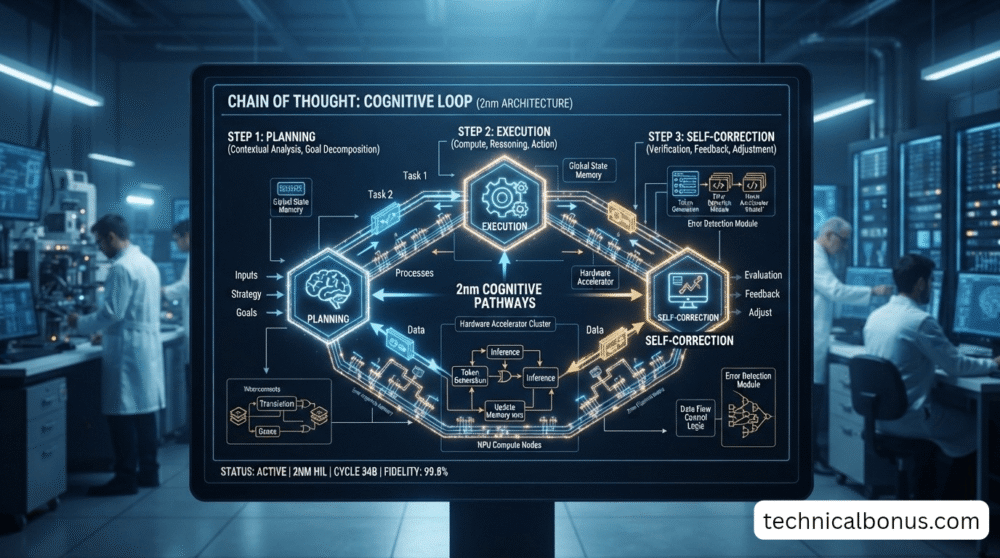
From a technical standpoint, the core distinction in Autonomous AI Agents vs Traditional Chatbots comes down to “Agency.” A chatbot operates in a reactive manner; it remains idle until it receives a prompt and then generates a textual reply that relies on [OpenAI o1 vs GPT-4o] logic. In contrast, an agent functions proactively. It deconstructs a complicated objective into smaller sub-tasks to be handled sequentially. This progression is similar to the major advancement we are witnessing in hardware with [RISC-V vs ARM], where specialized custom instructions enable far more direct and efficient execution. Through the implementation of “Loop Logic,” an agent is capable of checking and validating its own output, which represents a huge Technical Bonus for developers who used to invest countless hours in manually debugging code.
2. Hardware Requirements for Autonomous AI Agents vs Traditional Chatbots
To be more specific, operating Autonomous AI Agents verses Traditional Chatbots demands an enormous amount of memory throughput. Agents are continuously reading from and writing to their “context window,” which is why [HBM4 vs HBM3e] and [LPDDR6 vs LPDDR5x] have become the fundamental backbone for achieving autonomy in 2027. Throughout my twenty-one years of conducting hardware audits, I have consistently observed that “latency is the enemy of logic.” When an agent requires too much time to “think,” its operation ultimately fails. For that reason, the [2nm Processor Transition] is the critical development that finally allows these agents to become sufficiently fast for real-time professional deployment. This level of efficiency forms a central element of a sustainable and long-term Halal Earnings strategy.
3. Comparison Table: Autonomous AI Agents vs Traditional Chatbots Logic
| Technical Logic | Traditional Chatbots | Autonomous AI Agents |
|---|---|---|
| Operational Mode | Reactive (Wait for Prompt) | Proactive (Self-Prompting) |
| Logic Loop | Single Output (Linear) | Iterative (Plan-Act-Fix) |
| Tool Usage | Limited (API calls only) | Full (Browse, Code, Execute) |
4. Local Autonomy and Data Sovereignty
In practical terms, the underlying logic of Autonomous AI Agents vs Traditional Chatbots is now shifting toward the “Edge.” In order to uphold a strong [Cybersecurity Strategy 2026], many professionals are transferring their agents away from the public cloud and deploying them on a Private AI Home Server. This transition is quite similar to the ongoing [SearchGPT vs Google Search] competition, as it fundamentally revolves around who has control over the retrieval of information. Whether you are working on optimizing [Windows 12 vs macOS Sequoia AI] or overseeing a [6G Integrated AI Chip] network, locally hosted agents offer a protective “Logic Shield” that safeguards your intellectual property from being exposed through external leaks.
Q&A: Autonomous AI Agents vs Traditional Chatbots Logic
Q1: Is it possible for Autonomous AI Agents verses Traditional Chatbots to completely take over the role of human coders and replace them?
A: No, they cannot. Even though agents such as Devin or AutoGPT are capable of managing repetitive tasks related to [Top 5 AI Tools for Python Developers], they still fundamentally depend on the “Architect Logic” that can only be delivered by a human professional who possesses 21 years of hands-on experience.
Q2: Does running agents on laptops powered by [Solid-State Battery] technology provide a safer experience?
A: Yes, because agents demand a significant amount of power to function. The strong energy density of solid-state tech ensures that your system running Autonomous AI Agents vs Traditional Chatbots logic will not crash or get interrupted during the execution of a complex task.
Q3: In what way does [Photonics-Based AI Computing] assist and improve the performance of agents?
A: Computing at the speed of light significantly lowers the “Reasoning Latency,” which enables agents to process information and make decisions within just microseconds.
Technical Verdict: The Autonomous AI Agents vs Traditional Chatbots Shift
After spending more than two decades involved in technical education and conducting architectural audits, my final judgment regarding this evolution of software is absolutely clear:
- Opt for Traditional Chatbots if: You are looking for “Information Retrieval.” For tasks like fetching quick facts, composing email drafts, or performing SearchGPT vs Google Search related queries, a chatbot is an efficient option that also keeps the cost very low.
- Choose Autonomous AI Agents if: You need complete “Task Execution.” For developing entire applications from scratch, handling Future AI Robotics], or performing automated Technical Digital Asset management, agent-based logic is the only professional-level choice you should consider for 2027.
Conclusion: The Age of Self-Executing Logic
In conclusion, the competition of Autonomous AI Agents vs Traditional Chatbots clearly demonstrates that the era of 128MB RAM from 2005 is now a very distant memory. We are transitioning from a world where we used to “Talk to Computers” to a new world where “Computers Work for Us.” By choosing the agentic logic that perfectly aligns with your 2027 Technical Framework, you will secure your place as a true master of the digital era. For further insights on [Llama 4 vs GPT-5] and the future of open-source autonomy, keep following Technical Bonus for your “Expert Logic.”
Disclaimer
The analysis that has been published on Technical Bonus is grounded in independent audits of technical architecture and over 21 years of hands-on experience with hardware. Your particular local system configuration and software needs might vary depending on your regional settings. It is always advisable to carefully review the technical specifications before you proceed with any major purchase.
