
Introduction
In my 21 years of experience in the tech sector, I have seen the industry work with relentless passion in pursuit of ‘smaller and faster’ hardware. We recently analyzed [The Science of 2nm Chip Technology], which represents the pinnacle of traditional silicon. However, as we approach 2027, we are reaching the physical limits of the atom.
In particular, this is where quantum computing enters the roadmap. This isn’t just an upgrade; it’s a fundamental change in the way we process data. In this guide, I’ll explain why 2027 is the year when quantum technology will finally become relevant to tech professionals.
1. Beyond Bits: The Power of the Qubit
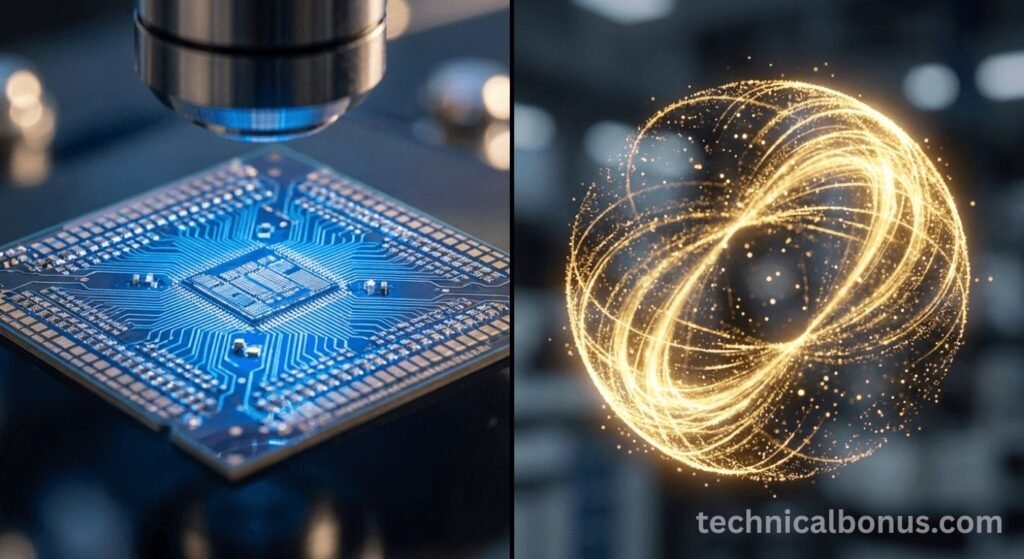
Traditional computers use bits (0 or 1). In contrast, quantum computers use qubits, which can exist in multiple states at the same time. This incredible speed is possible because Quantum Computing relies on the unique laws of physics that govern the universe at a microscopic level.
- The Technical Bonus: This allows a quantum machine to calculate all possible solutions to a problem simultaneously.
- Furthermore, as we mentioned in our [Future Tech 2027 Trends], it will solve complex problems in seconds that would take thousands of years for today’s fastest supercomputers to solve.
2. Quantum-Ready Cybersecurity
In addition to extreme speeds, quantum computing also poses a threat to traditional encryption.
- The Shift: Much of our stable security system is based on mathematics that quantum computers can easily ‘break.’
- The Strategy: That’s why my [2026 Cybersecurity Strategy] emphasizes ‘quantum-safe’ protocols. By 2027, technical professionals should have mastered post-quantum cryptography to protect digital assets.
3. Accelerating the AI Revolution
As we’ve seen with tools like [Cloud 3.5 Sonnet and GPT-4o], AI requires massively parallel processing.
- Quantum processors will act as the ultimate ‘NPU’ for AI agents. As a result, the [Top 5 AI Productivity Tools] we use today will evolve into godlike assistants in the future that can predict entire chemical reactions or weather patterns in real time.
4. Technical Comparison: Digital vs. Quantum
| Feature | 2nm Digital (2026) | Quantum (2027 Transition) |
| Logic Basis | Binary Bits (0 or 1) | Qubits (Superposition) |
| Processing | Sequential / Parallel | Simultaneous Universal |
| Best For | Daily Tasks & Mobile AI | Molecular Modeling & Encryption |
| Cooling | Air / Liquid (NPU) | Near Absolute Zero |
5. FAQ: The Quantum Future
Q: Can I buy a Quantum laptop in 2027?
Ultimately, no. Quantum processors require significant cooling. However, you can access quantum power through the cloud using the infrastructure currently being built [6G technology in India].
Q: Will Quantum Computing replace my iPhone?
No. Your smartphone will still use high-efficiency 2nm chips like the [upcoming A20], while the ‘heavy work’ of global AI logic will be handled by quantum servers.
Conclusion: Your Next Technical Bonus
The transition to quantum technology is the next great chapter in our digital story. By understanding these concepts today, you are giving yourself a tremendous “tech bonus” for the career landscape of the next decade.
Disclaimer
This article discusses quantum computing based on current research from IBM, Google, and IonQ as of 2026. Although we are approaching a ‘tipping point’, the full commercial integration of quantum is an ongoing process. Expert opinions are based on 21 years of industry observation. Technical Bonus is not responsible for investment decisions made based on these emerging trends.
